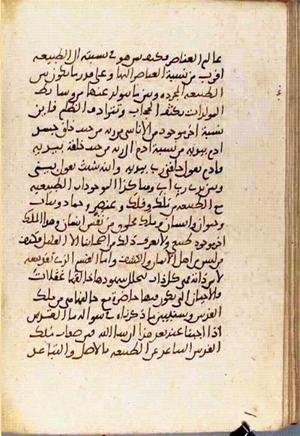
the world of the elements. What, then, of one whose relation to Nature is closer than the elements’ relation to it? In proportion to the intermediaries among generated things between abstract Nature and what is generated from it, the veil thickens and layers of darkness accumulate. How far is the relation to his Lord of the last human existent, insofar as He created Adam’s body with His two hands, from Adam’s own relation to his Lord insofar as He created him with His two hands! Adam says, “My Lord created me with His two hands,” while his son Seth says, “Between me and my Lord’s two hands stands my father.” Thus it is with natural existents in relation to Nature: angel, celestial sphere, element, inanimate thing, plant, animal, human being, and an angel created from a human breath. This angel is the last natural existent. Few of our companions know this, so what of those who do not belong to the people of faith and unveiling?
As for the kind whose sanctification does not arise from its own entity, it comprises every entity whose witnessing of its Creator is interrupted by moments of heedlessness. In the times when it is present with its Creator, it belongs to the dominion of holiness. We shall explain what we have mentioned in his question:
What is holiness?—when we answer it after this, God willing.
Among the attributes of the dominion of holiness, then, are distance from Nature through one’s origin, and distance
Notes
Translator’s note TN3735-1: The unvocalized nafs/nafas in the last natural existent can mean ‘soul’ or ‘breath.’ It is read here as nafas, ‘breath,’ in the sequence ending with an angel generated from a human being; the alternative reading ‘human soul’ remains possible.