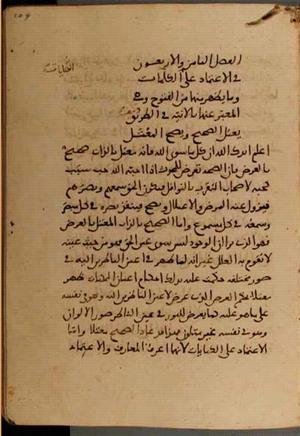
Section Forty-Eight: Reliance upon Pronominal Expressions and the Openings Appearing from Them, Called I-ness on the Path, and How the Sound Becomes Ailing and the Ailing Sound
Know—may God support you—that everything other than God is intrinsically ailing and accidentally sound. Soundness comes accidentally to the originated being when God loves him through a love arising from a cause, as He loves those drawing near through supererogatory acts. The Real becomes their hearing and sight. Sickness and ailment depart from him, and he becomes sound. His sight penetrates every visible thing and his hearing every audible thing.
As for what is intrinsically sound but accidentally ailing, this concerns the view that existence is none other than the Real’s very entity. In His entity, ailments do not inhere in Him. But when He appears to beholders’ eyes in different forms, through which the rulings of possible things’ entities govern Him, He appears ailing through the accident affecting the beholders’ eyes,[45] while remaining in Himself as He is. Colors’ forms likewise appear upon light in the beholder’s eye, although in itself it is uncolored. Thus the sound has become ailing.
(Pronominal Expressions and Determining the Known)
Reliance upon pronominal expressions is because they are the most definite of definite expressions. Reliance
Notes
[45]
(The wording “لا عين” was corrected to “لأعين,” “to the eyes,” by comparison with the new edition.)
Translator’s note TN5228-1: I-ness renders the Path’s īniyya. The opening relative clause of the intrinsically sound case, fa-huwa alladhī yarā anna al-wujūd ..., is compressed. The rendering takes its subject as existence viewed as the Real; the unvowelled yarā/yurā admits an active or passive reading.