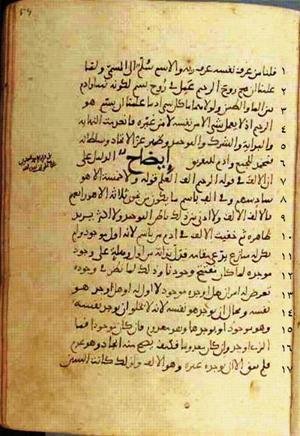
of everything”—this is the Preserved Tablet—“an admonition and a detailed explanation of everything” [al-Aʿrāf 7:145]: this is the all-comprehensive Preserved Tablet. This expresses the Prophet, may God bless him and grant him peace, in his saying, “I have been given all-comprehensive words.” “An admonition” and “a detailed explanation”: these are the two dots of command and prohibition. “Of everything”: the two are the unseen dimension of Muḥammad, which is the alif indicated by the blessed night.
Alif thus belongs to knowledge, and is the place of establishment; lām belongs to will, and is the nūn—I mean the inkwell; rā belongs to power, and is the Pen; ḥā belongs to the Throne; yā to the Footstool; the head of mīm to heaven; and its descending tail to earth.
These are seven stars:[48] one swims in the sphere of the body; one in the sphere of the rational soul; one in the sphere of the soul’s secret, which is utter truthfulness; one in the sphere of the heart; one in the sphere of the intellect; and one in the sphere of the spirit. Unlock what we have locked. In what we have established is a key to what we have concealed. Seek, and you will find, God willing. Thus “In the name of God, the All-Merciful, the Ever-Merciful,” although multiple, is one when realized from a certain perspective.
Section: On the Secrets of the Mother of the Qur’an from a Particular Perspective
It is the Opening of the Book, the Seven Oft-Repeated, the Mighty Qur’an, and the Sufficient. The basmalah is a verse of it, and it comprises the Lord and the servant. We have a piece of verse on its division,[49] including these lines:
The two luminaries rise within the heart;
In the Sūrah of Praise no third appears beside them.
Notes
[48]
(He calls the stars seven, but the enumeration here contains six. Both the number and the details have been retained as supplied.)
[49]
Qarīḍ was explained earlier: metrical passages of verse excerpted from the established poetic metres.
Translator’s note TN432-1: The title “the Seven Oft-Repeated” translates al-sabʿ al-mathānī. The discussion below also draws on the word’s sense of doubling or pairing, relating it to the two presences of Lord and servant.