perfection lay only in sheltering you.
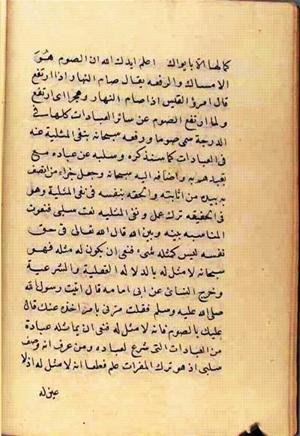
Know, may God support you, that fasting, ṣawm, means abstention and elevation. One says that the day ṣāma when it rises high. Imruʾ al-Qays said, “When the day is high and blazes,” meaning that it rises.
Fasting is called ṣawm because it rises in rank above all other acts of worship. He, glory be to Him, elevated it by denying that it has any likeness among acts of worship, as we shall mention. He removed it from His servants even while requiring them to worship through it, ascribed it to Himself, and took into His own hand the recompense of the one characterized by it.[6] He joined it to Himself in having no likeness.
In reality it is abstaining, not acting, and having no likeness is a negative attribute. Its correspondence with God is thus strengthened. The Exalted said of Himself, “Nothing is like Him” [al-Shura 42:11], denying that He has any likeness. He, glory be to Him, has no likeness according to both rational proof and the revealed law.
Al-Nasāʾī transmitted from Abū Umāmah: I came to the Messenger of God, may God bless him and grant him peace, and said, “Command me to do something I can take from you.” He said, “Take up fasting, for it has no likeness.” He thus denied that any act of worship prescribed for His servants resembles it.
Whoever knows that it is a negative attribute, since it consists in abstaining from what breaks the fast, knows with certainty that it has no likeness, for it has no
Notes
[6]
(The reading “rewarding him” was corrected by comparison with the newer edition, in the context of the Real undertaking the fasting person’s recompense.)