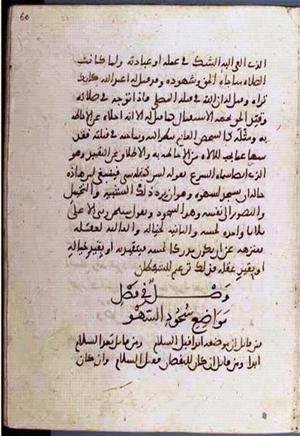
who cast doubt into his mind about his deed or his worship.
(Affirming Freedom from the Limits of Sense, Imagination, and Intellect)
Prayer is intimate converse with the Real and witnessing Him. The worshipper has been told, “Worship God as though you see Him,” and, “God is in the direction faced by the one at prayer.”
When he turns in prayer and confines the Real to the direction he faces, as he was told, while leaving out His encompassing the worshipper, and pictures Him as a person standing before him in that direction whom he sees and addresses intimately, he has forgotten what belongs to God, His encompassing him and His freedom from restriction. The revealed law also expresses this in His words, “Nothing is like Him” [al-Shura 42:11].
Someone in this state should prostrate for his forgetfulness. He returns the comparison, the imagining, and the forming of an image to himself. This is the prostration. He says, “Glory be to my Lord, the Most High,” three times, once for his senses, once for his imagination, and once for his intellect. He declares Him too incomparable to be apprehended and restricted by his senses, or by the limits of his imagination or intellect. That humiliates the devil.
Continuation on When to Prostrate for Forgetfulness
Some say that it is always before the salutation. Some say that it is always after the salutation. Others say that if it is for an omission, it is before the salutation, and if it is
Notes
Translator’s note TN2014-1: The argument distinguishes God’s being “in the direction” the worshipper faces from a spatial restriction imposed by the worshipper’s own faculties. The Arabic pronouns in the passage about encompassing are compressed. The translation understands them as referring to God’s encompassing the worshipper.