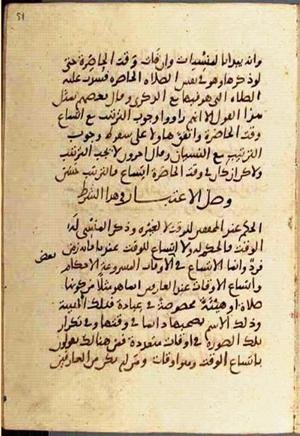
and that one begins with the forgotten prayers even if the time of the current prayer passes. If he remembers them while he is performing the current prayer, the prayer he is in becomes invalid on his remembering.
Others say the same, except that they hold order obligatory only if the current prayer’s time is ample. They agree that the obligation of order falls away with forgetting.
Others say order is not obligatory, though it is good to observe it if the time of the current prayer is ample.
Continuation on the Inward Application of This Condition
(The Ruling of the Moment and Its Extension)
For the people of realization, the ruling belongs to the moment alone. The remembrance of the forgotten prayer has its moment, and the ruling belongs to it. In our view the moment has no extension, for it is an indivisible time[45]. Extension occurs only in some of the times for which rulings have been prescribed.
The extension of times for the knowers is, for example, in respect of something’s being prayer or a particular form within worship. That form and that name always accompany it in its time, and accompany the recurrence of that form at multiple times. From this perspective they speak of the extension of time, though these are multiple times.
Any knower who is not
Notes
[45]
(The author distinguishes the present moment, in which a ruling becomes determinate, from the extension of the name or form of worship across multiple moments. The second explains speaking of an extended time.)
Translator’s note TN1996-1: The indivisible moment is distinguished from the repetition of an act under the same form and name. An extended interval in the latter sense contains multiple moments.