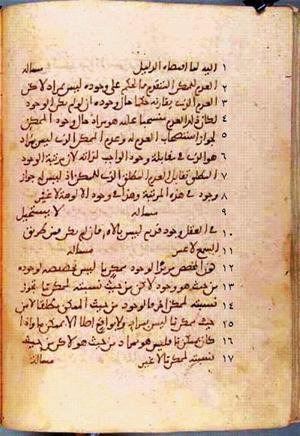
on the basis of what the proof requires.
Question (37): (The Nonexistence of the Possible)
The nonexistence of a possible thing, prior in ruling to its existence, is not willed. But the nonexistence that accompanies it in ruling while it exists—such that, were existence absent, that nonexistence would extend over it—is willed while the possible thing exists, since nonexistence could continue to apply to it.
The nonexistence of the possible that is not willed is that which stands opposite the existence of the Necessary in Itself. For the rank of absolute existence stands opposite the absolute nonexistence belonging to the possible, since the possible cannot exist at this rank. This pertains only to the existence of Divinity (not to the existence of the Essence).
Question (38): (The Existence of Something Beginningless)
The existence of something beginningless that is not God is not rationally impossible. If no such thing exists, this is established only through transmitted revelation (that is, reason does not rule it out; our proof that nothing beginningless exists other than God is transmitted, not rational).[199]
Question (39): (Specification and Will)
The Specifier’s willing the existence of a particular possible thing is not His specification of existence as existence, but of existence in relation to a particular possible thing, when it could relate to another possible thing. Existence in respect of the possible in general, rather than a particular possible thing, is neither willed nor realized at all except through some particular possible thing. When it is through a particular possible thing, it is not willed as existence in itself, but only in its relation to that particular possible thing.[200]
Question (40): (The Self-Sufficiency of the Necessary Existent)
Notes
[199]
Ibn al-Arabi discussed the differing views on the possibility of something beginningless existing with God in Kitab al-Azal, printed in the Hyderabad collection Rasail Ibn Arabi.
[200]
This is an extremely important conclusion that explains the principle of sequential creation. The existence of the possible—that is, the cosmos—does not occur all at once, as we imagine and see through our imagination. In reality, the entities of existents, whose existence is possible, acquire existence one after another through the Necessary Existent—God, glory be to Him, the Creator and Originator—giving them preponderance. We explained this principle in detail and adopted it as one of the foundations of the Single Monad theory, set out in Nazariyyat al-Jawhar al-Fard and Mafhum al-Zaman inda Ibn al-Arabi (p. ??? [reference unfinished in the source]).