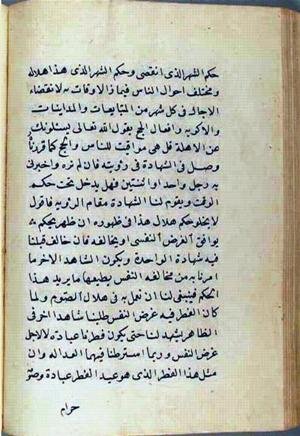
the ruling of the month that has ended and of the ruling of the month whose crescent it is. People’s states differ, and times are distinguished through it because terms fall due in every month for sales, debts, rents, and the acts of pilgrimage. God Most High says, “They ask you about the crescents. Say, ‘They are times appointed for people and pilgrimage’” [al-Baqarah 2:189], as we have established.
Continuation on the Section Concerning Testimony to Its Sighting
If we do not see it and one or two men inform us of it, do we enter under the moment’s ruling, with testimony taking the place of sighting for us?
I say that the crescent’s appearance must bring a ruling that either accords with the soul’s aim or opposes it. If it opposes it, we accept one person’s testimony. The other witness is the command given us to oppose the soul. By its nature the soul does not desire this ruling, so we should act upon it in the crescent of fasting.
Since breaking the fast contains the soul’s aim, we seek another outward witness to testify for us, so that our breaking the fast may be worship, free of the soul’s aim. We may require uprightness in both.
Such breaking of the fast, the Feast of Fast-Breaking, is worship, and fasting it is