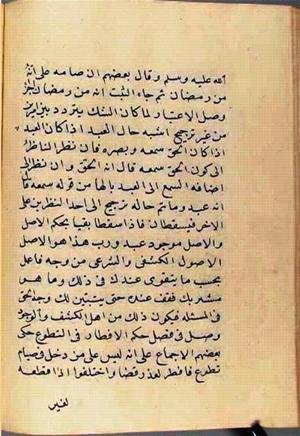
may God bless him and grant him peace.
Some say that if he fasted it as part of Ramadan and it was then established that it was part of Ramadan, it suffices.
Continuation on the Inward Application
Since doubt wavers between two things without preferring either, it resembles the servant’s state when the Real is his hearing and sight. If the observer considers that the Real is his hearing, he says it is the Real. If he considers the ascription of hearing to the servant through the possessive ending in “his hearing,” he says it is a servant.
There is no state that gives one consideration precedence over the other, so both fall away. When they fall away, the two remain under the ruling of the original principle, the existence of a servant and a Lord. This is the original principle of reflection and of the revealed Law in one respect.
The origin of that origin, considered before this principle and indeed the principle of which this one is a branch, is the existence of a Lord in the very entity of a servant. This is the root of roots in unveiling and, in one respect, in the revealed Law.
Act according to what gains strength with you in this matter and according to your source of drinking. Remain there until the face of truth in the question becomes clear to you. You will then belong to the people of unveiling and finding.
Continuation on the Ruling of Breaking a Voluntary Fast
Some have related agreement that one who begins a voluntary fast and breaks it for an excuse is under no obligation to make it up. They disagree if he breaks it
Notes
Translator’s note TN2705-1: The two considerations are God as the servant’s hearing and the ascription of that hearing to the servant. The subsequent distinction is between an original principle of reflection and one disclosed in unveiling.