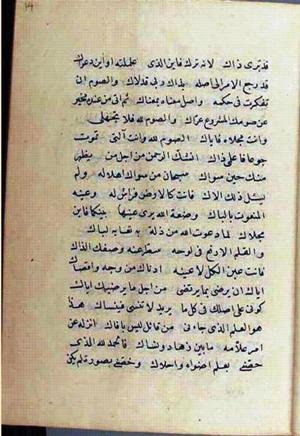
so ponder that.
It is abstaining. Where, then, is the deed
you have done, or where is your claim?
The affair has returned to its source.
Through this my Lord has taken charge of you.
Fasting, if you reflect upon its ruling,
joins its meaning to your meaning.
Then from His presence came one to report,
who stripped you of your prescribed fast.
Fasting belongs to God, so do not be ignorant,
and you are His locus of disclosure. Beware!
Fasting belongs to God, while you are she
who dies of hunger. Know that.
The All-Merciful made you female for the One
who appears from you when He proportioned you.
Glory be to Him who fashioned you fit for Him,
for none but you attained that.
You are like the earth, a bed for Him,
and His eye is what is described as weeping.
The very reality of God’s handiwork is seen
between the two of you. Where, then, is your locus of disclosure?
When you called on God out of intimacy with Him,
through Him, exalted is He, He answered you through you.
The highest Pen in its Tablet
recorded from Him your pure description.
You are the very reality of all, though not His very reality.
He drew you near in one respect and put you far away.
Beware of being content with what you approve
for the sake of what pleases you. Beware!
Remain at your source in everything
He wills. Do not forget, lest He forget you.
This is the knowledge that came to me
from a speaker who is no liar.
He sent it down at the command of the One who knows it,
among renunciants and devoted worshippers.
Praise belongs to God, who singled me out
for knowledge of lights and darknesses,
and singled me out with a form whose
Notes
Translator’s note TN2552-1: The soul is addressed as feminine, made explicit in the line about the All-Merciful making it female. The poem uses ʿayn for both eye and very reality, and its pronominal references remain compressed. “His very reality” in the line contrasting the whole and its source takes the masculine pronoun as referring to God.
Translator’s note TN2552-2: The phrase rendered “out of intimacy with Him,” min dallihi, is uncertain in this compressed line. The translation reads dall as the familiarity of intimate love.