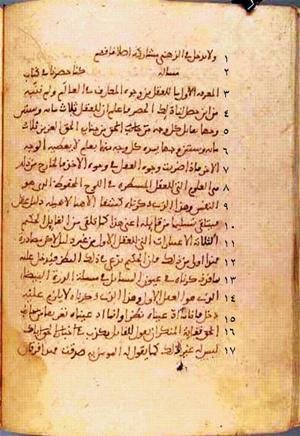
whereas no such shared designation enters into the mental representation at all. Understand this.
Question (57): (Enumerating the First Intellect’s Aspects of Knowledge)
In the first Book of Knowledge,[205] we enumerated the intellect’s aspects of knowledge in the cosmos, but did not indicate how we arrived at this enumeration. Know, then, that the intellect has three hundred and sixty faces. Each face encounters, from the side of the Mighty Real (that is, the Greatest Element, which is the Real through whom creation occurs), three hundred and sixty faces; each of these supplies it with knowledge that the other face does not give.
If you multiply the intellect’s faces by the faces from which it receives, the result (360 × 360 = 129600) is the knowledge possessed by the intellect and inscribed upon the Preserved Tablet, which is the Soul. What we have mentioned is a divine unveiling that no rational proof renders impossible; it is therefore to be received with acceptance from the one who states it. I mean that it should be received just as the three considerations belonging to the First Intellect are received from the philosopher[206] without proof, merely by postulation.
This is more deserving of acceptance than that. The philosopher claims to have arrived at it through reasoning, and so he may be challenged by what we have mentioned in Uyun al-Masail[207] concerning the question of the White Pearl,[208] which is the First Intellect.
What we have mentioned is not subject to such a challenge (that is, a demand for proof), for we have not claimed it as a result of reasoning, but as knowledge imparted to us. The most the denier can say to its speaker is, “You are lying”; he has no other response, just as the one who believes him says, “You have spoken truly.” This is a distinction—
Notes
[205]
Uthman Yahya transcribed this as “the Book of First Knowledge,” without explanation. The correct reading is the one we have given. The Book of Knowledge is also called the Book of Questions and is listed as no. 191 in the Ijazah. It is also printed separately within volume 4 of the collection Rasail Ibn Arabi, Muassasat al-Intishar, Beirut, 2002–2004.
[206]
It is not entirely clear who is meant by “the philosopher.” He may mean philosophers generally, or refer specifically to Ptolemy, to whom such a statement is attributed and from whom Ibn Sina appears to have transmitted it.
[207]
He may mean al-Rasail fi al-Ajwibah an Uyun al-Masail, listed as no. 68 in the Ijazah. Perhaps it is the same work as al-Wasail fi al-Ajwibah an Uyun al-Masail, listed as no. 185 in the Fihrist.
[208]
This is the treatise al-Durrah al-Bayda, printed in Beirut in 1923 and recently reprinted in volume 3 of the collection Rasail Ibn Arabi, Muassasat al-Intishar, Beirut, 2002–2004. Uthman Yahya did not include it in his list of works mentioned by Ibn al-Arabi in this volume (p. 486). Ibn al-Arabi also mentions it in Uqlat al-Mustawfiz (p. 656) as “An Answer to the Question of the White Pearl, Which Is the First Intellect.”
Translator’s note TN161-1: “Faces” here are aspects of reception or relation. The author expressly presents the number 129600 as knowledge received through unveiling, not as a conclusion established by rational demonstration; the translation retains that distinction.