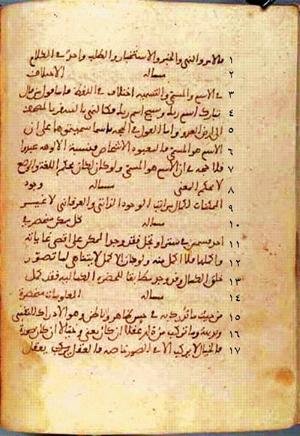
Thus command, prohibition, report, inquiry, and request are one in speech.
Question (47): (The Name, the Named, and Naming)
Disagreement over the name, the named, and naming is a disagreement about wording. As for the argument drawn from His sayings, “Blessed is the Name of your Lord” [Qur’an 55:78] and “Glorify the Name of your Lord” [Qur’an 87:1], it is like the prohibition against travelling with the written Qur’an to enemy territory.[202] As for arguing from “names that you have named” [Qur’an 53:23; 7:71] that the name is the named: what is worshipped (under these names) is the individual beings. It is the attribution of divinity that they worship (not the name). This therefore provides no proof that the name is the named. Even if it were, that would be by linguistic convention and designation, not by meaning.
Question (48): (The Existence of Possible Things)
Possible things exist only for the completeness of the levels of existence in entity and in knowledge (otherwise, they already exist in knowledge before their existence in actuality).
Question (49): (The Divisions of the Possible)
Every possible thing belongs to one of two divisions: concealment or self-disclosure. The possible has thus come into existence at the utmost and most complete of its limits, and nothing is more complete than it. If what is more complete had no end, the creation of completeness could not be conceived. Yet it has come into existence in conformity with the Presence of Completeness, and so it is complete.
Question (50): (The Classification of Objects of Knowledge)
Objects of knowledge, in respect of that by which they are apprehended, are confined to outward sense, inward sense—which is the soul’s perception—[203] immediate self-evidence, and what is composed from these: intellectually if it is a meaning, and imaginatively if it is a form. Imagination composes only forms. The intellect apprehends—
Notes
[202]
This occurs in several reports in Sahih al-Bukhari, Sahih Muslim, and elsewhere. Imam Muslim devoted a chapter to it in his Sahih: “The prohibition against travelling with the written Qur’an to the land of unbelievers when it is feared that it may fall into their hands.” He mentions, for example, a report from Abd Allah ibn Umar that the Prophet—may God bless him and grant him peace—used to prohibit travelling with the Qur’an to enemy territory, for fear that the enemy might obtain it. Sahih Muslim, vol. 3, hadith no. 24.
[203]
Uthman Yahya transcribed this as “inward perception,” without indicating his source. In the manuscript it is as we have given it; this appears to be a printing error in his edition.