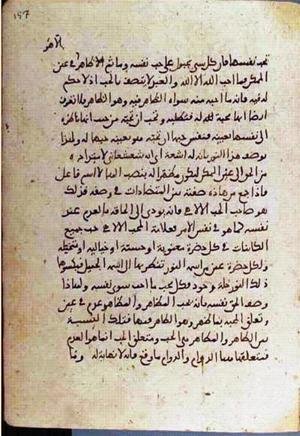
loves itself. Everything is innately disposed to love itself, and none is manifest but “He” in the possible entity. Only God loves God. The servant is not characterized by love, since he has no ruling in it: none within him loves Him except He who is manifest within him, the Manifest. Again, it does not know that it loves Him, so it seeks Him and loves to love Him, insofar as it looks upon itself through His eye. Its very love of loving Him is precisely its love for Him. For this reason this light is described as having rays, as radiant, because it extends from the Real to the possible entity so that it may be a locus of manifestation for Him—with a fatḥa upon the hāʾ, not an active participle. When one of this description combines opposites in his description, he is the possessor of divine love. It leads to his being consigned to nonexistence in his own regard, as he is in the matter itself.
The sign of the divine lover is love of all engendered beings in every presence, whether of meanings, sense, imagination, or imagining. Each presence has an eye from His name the Light, with which it looks toward His name the Beautiful. That light clothes it in a robe of existence. Every lover loves only himself. For this reason the Real described Himself as loving the loci of manifestation. The loci are nonexistence within an entity, while love’s attachment is to what appears, and He, exalted is He, is what is manifest within them. That relation between the Manifest and the loci of manifestation is love. Love’s object of attachment is only nonexistence. Here its object is perpetuity, and perpetuity has not occurred, for it has no end, and what
Notas
Translator’s note TN3750-1: The author expressly requires maẓhar, “locus of manifestation,” with an open vowel on hāʾ, rather than an active participle meaning one who manifests. “Perpetuity has not occurred” concerns an endless duration that cannot have occurred as a completed whole; its endlessness is the reason supplied in the text.